
State Memos on Shared Use Liability
Liability risks for use of public school property during non-school hours
To assist advocates and local government attorneys in assessing liability risks, we commissioned a 50-state survey of the laws governing liability for recreational use of school facilities during non-school hours.
Written by Professor Tom Baker, Professor of Law at the University of Pennsylvania Law School and one of the nation’s preeminent scholars of tort and insurance law, the survey results consist of two parts that are designed to be read together. There’s good news for local governments supporting these efforts:
- All 50 states have some form of governmental immunity that protects public entities from liability;
- Some states have recreational users statutes that protect property owners, including public entities, who allow others to enter their property for recreational purposes; and,
- In no state are rules governing recreation use during non-school hours more onerous than rules that apply during school day.
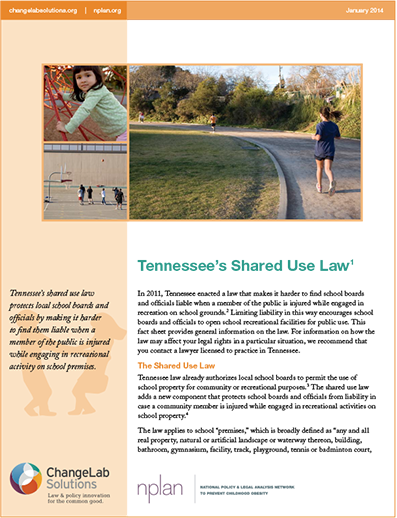
In 2013, we revised seven of the state memos and developed two fact sheets that address new shared-use legislation in Mississippi and Tennessee. The updated state memos should be read with the overview memo, which sets the analytical framework for assessing a school’s liability risks. The overview memo covers:
- Basic elements of tort liability;
- Special legal rules that may limit public schools’ legal obligations;
- Statutory limits on the damages that may be awarded; and,
- Potential tools for shifting liability risks (liability waivers and providing access through third parties).
The state memos do not provide the kind of detailed analysis necessary to support the defense of a liability action, nor are they a substitute for consultation with a lawyer. If there are important cases, statutes, or analyses that we have overlooked, please contact us and let us know.
Downloads
Related Resources
Black Graphics