
Sugary Drink Strategy Playbook
Reducing sugary drinks to promote community health & equity
Public health experts have identified sugary drinks as significant contributors to poor diet, decreased community health, and unjust health disparities.
Across the country, governments, institutions, and local leaders are stepping up to address sugary drink overconsumption in order to improve community health and equity.
Sugary drinks (also called sugar-sweetened beverages, or SSBs) are any non-alcoholic beverages that contain added caloric sweeteners, like non-diet soda, fruit ades, sports drinks, energy drinks, sweetened waters, and sweetened coffee and tea beverages. These commonplace beverages are at the nexus of many important health equity issues, such as lack of nutritious food options for low-income families and targeted marketing to underserved communities.
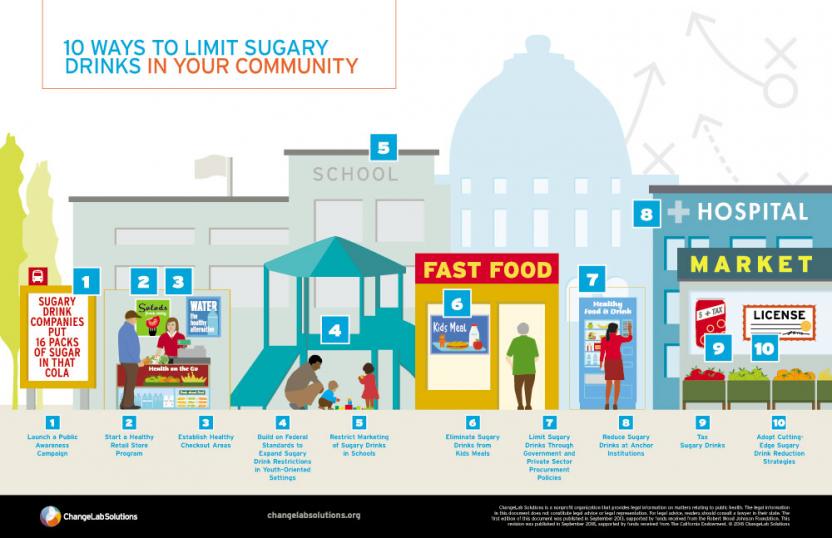
ChangeLab Solutions developed the Sugary Drink Strategy Playbook and companion infographic to provide an overview of 10 common and cutting-edge strategies for communities to reduce consumption of sugary drinks. In addition to updated information on the latest public health science and the legal landscape, the revised playbook includes these features:
- Health equity in focus boxes that highlight equity considerations and challenges for sugary drink reduction strategies
- Collaboration & engagement sections that offer guidance on generating support for sugary drink reduction strategies through multisector collaboration and community engagement
- Strategy in action examples that document real-world implementation of specific strategies
- Key resources for leaders who want to learn more about a particular strategy
Changemakers often ask, “Where do we start?” The Sugary Drink Strategy Playbook assists communities that are just getting started, as well as those that have already proposed or implemented strategies to reduce sugary drink consumption. This playbook is meant to help generate ideas for a sugary drink reduction strategy and outline some important considerations along the path forward. While no single strategy is likely to correct sugary drink inequities or radically boost community health, a collection of strategies—such as those listed in the playbook—can work together to move the dial.
The Sugary Drink Strategy Playbook focuses on local strategies to address overconsumption of sugary drinks, but some of these strategies can be adopted for statewide implementation. If you have a question about the adaptability of any of the strategies for your community, please contact ChangeLab Solutions or a local attorney.
For information on regulating sugary drinks via taxes, see our companion guide coauthored by ChangeLab Solutions and Healthy Food America, A Legal and Practical Guide for Designing Sugary Drink Taxes, created for local officials and advocates who are interested in pursuing sugary drink taxes.
Related Resources

Black Graphics